

Data Protection Training For Cybersecurity Firms
When your business handles the most sensitive security data imaginable, data protection isn’t optional – it’s mission-critical. Learn how to protect your clients’ intelligence while staying compliant with UK GDPR Regulations and ICO guidance.

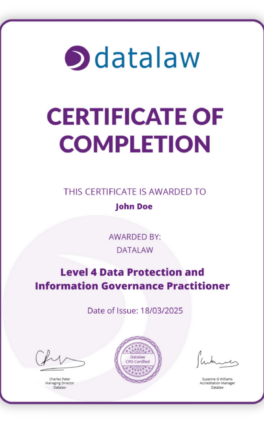
Trusted Provider For Over 27,000 Professionals

Overview of Datalaw’s Data Protection Training For Cybersecurity Firms
Cybersecurity firms operate in a unique compliance landscape. You manage penetration test reports, vulnerability assessments, incident response data, forensic investigation records, proof-of-concept exploits, and classified client network architecture. Every piece of data is both a business asset and a compliance liability.
Our specialist training equips your team to navigate the intersection of ethical hacking, responsible disclosure, and strict data protection law. You’ll master confidentiality agreements, secure evidence handling, breach reporting obligations, and the overlapping requirements of GDPR Regulations – all designed for your sector’s real-world challenges.
- Government Funded Pathway: Level 4 Data Protection Officer Apprenticeship
- Private Pathway: UK GDPR DPO Practitioner Course
Download Our Free Brochure
Discover how our Data Protection Training Programme is tailored specifically for cybersecurity firms. Download our free brochure to explore learning pathways, funding options, and real-world case studies on managing sensitive security intelligence compliantly.
Government Funded Route
Level 4 Data Protection Officer Apprenticeship
The government-funded Level 4 Data Protection Officer Apprenticeship is ideal for cybersecurity firms investing in long-term compliance leadership. Apprentices gain a formal qualification in information governance whilst learning to handle sensitive security data with confidence.
- Up to £10,000 government funding available (levy or co-funded)
- Recognised qualification in Data Protection & Information Governance
- No formal exams – assessed through portfolio and professional discussion
- Flexible learning designed to fit around your operations
- Ideal for building internal capability and long-term compliance oversight
Private Route
UK GDPR DPO Practitioner Course (3 Days)
Our intensive 3-day UK GDPR DPO Practitioner Course covers everything cybersecurity firms need: confidentiality protocols, breach notification timelines, forensic data handling, client contractual obligations, and NIS Regulations overlap.
- 3-day intensive training programme
- £1,250 + VAT (one-off cost, employer or individual funded)
- Covers UK GDPR, data breaches, SARs, and cybersecurity firms-specific risks
- Practical, scenario-based learning tailored to cybersecurity firms
- Ideal for existing staff needing quick, focused upskilling
420+
Organisations in the UK Trust Datalaw for Legal & Data Training
27,000+
Professionals Have Chosen Us as their Training Provider
90%
Learner Satisfaction for Our Online Training and Support
Benefits of Data Protection Training for Cybersecurity Firms
Penetration Test Documentation
Learn compliant frameworks for capturing, storing, and sharing test results whilst protecting client confidentiality and adhering to responsible disclosure timelines.
Breach Response & Forensics
Master breach notification obligations, evidence preservation, incident response reporting, and working with law enforcement whilst maintaining GDPR compliance.
Vulnerability Management
Understand how to classify findings, prioritise remediation, communicate risk to clients, and document decision-making processes in a legally defensible manner.
Client Data Protection
Develop contracts that clarify data processor responsibilities, liability allocation, and breach notifications – essential for any firm handling client network data.
NIS Regulations & GDPR
Navigate the overlap between National Infrastructure Strategy guidance, NCSC advice, and GDPR requirements specific to critical infrastructure support roles.
Team Accountability
Build a culture where every team member – from analysts to project managers – understands their role in protecting client intelligence and maintaining ethical standards.

Next Steps
Getting your cybersecurity firm compliant with UK data protection law is straightforward. Here’s what to do next:
- Review your current data handling practices against the training curriculum to identify gaps
- Contact our training coordinators to discuss funding options and apprenticeship pathways
- Schedule a discovery call to align the programme with your team's specific roles and challenges
Common Data Protection Challenges in Cybersecurity Firms
Cybersecurity firms face distinct data protection challenges that generalist training simply doesn’t address. Here are the key obstacles our training helps you overcome:
- Balancing client confidentiality with breach notification obligations and law enforcement cooperation
- Managing proof-of-concept exploits and sensitive threat intelligence within compliant storage systems
- Drafting penetration test contracts that clearly allocate data handling responsibility and liability
- Training engineers on responsible disclosure timelines whilst maintaining GDPR compliance
- Documenting forensic investigations in ways that preserve legal admissibility and client privilege
- Navigating NIS Regulations overlap when supporting critical infrastructure clients or operators
Our training tackles these challenges head-on, giving your team the confidence and practical know-how to manage personal data properly, every day.

What Happens If You Get It Wrong?
When cybersecurity firms mishandle data protection, the consequences are severe – and they damage both compliance standing and client trust:
- Inadequate breach reporting leading to ICO enforcement action, fines up to 10 million pounds or 2% of global turnover, and reputational damage
- Client data breaches caused by poor storage practices, resulting in liability claims and loss of high-value contracts
- Forensic evidence dismissed in court due to inadequate chain-of-custody documentation or GDPR violations
- Penetration test findings disclosed prematurely, violating responsible disclosure agreements and client contracts
- Proof-of-concept exploits leaked or mishandled, exposing you to criminal liability and civil litigation
Get More Information From One of Our Expert Training Coordinators
Get information on start dates, funding, how to apply, employer support, and more.
Why Cybersecurity Firms Choose Datalaw
Cybersecurity firms choose Datalaw because we understand your sector’s unique compliance needs. Our training combines real-world incident response experience with formal legal training:
- Sector-specific case studies drawing on actual penetration test projects, breach investigations, and forensic workflows
- Expert trainers with experience in cybersecurity operations, client engagement, and regulatory compliance
- Practical frameworks for documenting sensitive findings, managing client contracts, and handling breach notifications
- Certification recognised by ICO, NCSC, and critical infrastructure assessors for firms supporting regulated clients
- Ongoing support including updates on NIS Regulations, GDPR case law, and industry best practices

Join Our Community


Frequently Asked Questions
Your firm manages intelligence that is simultaneously highly sensitive and subject to strict legal requirements. Generalist GDPR training ignores the unique challenges of handling penetration test data, forensic evidence, and proof-of-concept exploits. Our programme is built around real cybersecurity workflows – from initial assessment to breach response – and teaches compliant data handling at every stage.
Penetration test reports often contain personal data: employee names, email addresses, system access patterns, or device information. Under GDPR, these must be processed lawfully, stored securely, and deleted when no longer needed. You must have a legal basis, a processor agreement with your client, and a retention schedule. Our training covers all three.
If your firm discovers or becomes aware of a breach affecting your client’s personal data, you must notify the ICO within 72 hours (unless risk is low) and potentially notify affected individuals. You must also document the breach, conduct a root cause analysis, and demonstrate to the ICO that you took appropriate technical and organisational measures. Our training walks through the entire notification process.
If you support critical infrastructure operators or essential services, NIS Regulations require you to maintain security measures and report significant incidents to the NCSC. These requirements sit alongside GDPR obligations. Our training clarifies where GDPR ends and NIS begins, and how to design processes that satisfy both.
Yes, but with careful controls. POC exploits must be stored separately from client data, encrypted, access-restricted, and deleted to a defined schedule. Your storage system must be documented, your team trained, and your controls regularly tested. Our training covers secure storage architecture, access logging, and destruction procedures specific to sensitive cybersecurity assets.
Approved Training Provider
Datalaw is an approved provider of data protection and information governance training for cybersecurity firms across the UK. Our qualifications are recognised by the Information Commissioner’s Office (ICO), the National Cyber Security Centre (NCSC), and firms supporting critical infrastructure under NIS Regulations. We specialise in training cybersecurity professionals, incident responders, forensic investigators, and compliance teams to handle sensitive intelligence within strict legal frameworks. Whether you’re a boutique ethical hacking firm, a large managed security services provider, or an internal security team, our programmes are designed to build genuine compliance capability and reduce your organisation’s data protection risk.